

Nobody’s Checking Your Vial (So You’d Better Know What You’re Buying)

I was at the gym a few months back, the kind of place where the guys by the squat rack always seem to know something you don’t. One of them, let’s call him Marcus, pulled a little cooler bag out of his gym bag between sets and said, low-voice, like he was letting me in on something, “This is for my immune system. Peptide stuff. My guy sources it clean.”
Here’s the thing. Marcus’s guy is not a pharmacist. Marcus’s guy is not a doctor. Marcus’s guy is a website. And once that vial landed on Marcus’s doorstep, nobody, and I mean nobody, checked whether it was actually safe to put in his body. No clinician looked at his chart. No pharmacy held it to a standard. If something in that bottle turned out to be wrong, there was no one down the chain who’d answer for it.
I’m not telling you this to scare you off the topic entirely. I’m telling you because I think most people ordering these things have no idea that’s the deal they’ve made. Let me be straight with you about what these compounds are, what the evidence actually says, and how to choose without getting hurt, because most of the pain in this category isn’t from the molecules. It’s from nobody ever explaining the rules of the game.
Most of what we’re talking about here, thymosin alpha-1, thymulin, LL-37, glutathione, VIP, isn’t FDA-approved for immune use in the U.S. Some of it only shows up legitimately as a compounded prescription. Some of it is just powder in a bag with a label somebody printed themselves. Knowing the difference is most of the battle.
Pick your reason before you pick your peptide
The first trap people fall into is treating “immune peptides” like one category, one decision. It’s actually five very different molecules with five different mechanisms, and, honestly, five wildly different piles of human evidence. Before you spend a dollar, sit with two questions.
First: what’s actually going on with you? If you’re healthy and just hoping to give your immune system a boost, I have to be honest, none of these compounds is proven to do that. The research doesn’t support it. Keeping your wallet closed is a perfectly smart move here. If you have an actual medical reason, that’s a conversation for a clinician, not something you solve by adding to cart.
Second: how good is the evidence for the specific thing you’re looking at? Don’t let “peptides help immunity” satisfy you as an answer, because it’s not really an answer at all. Thymosin alpha-1 has, by a wide margin, the most real human research behind it [3]. The rest each have, at best, a single narrow study in people, and one of them is mostly test-tube and animal work. If you can’t explain the evidence for your compound in one honest sentence, you’re not ready to buy it.
The vial has two ingredients, and you can only see one of them
Here’s what I want to hammer home, because it’s where people actually get hurt. With an injectable, the molecule itself usually isn’t the danger. Who made it, and how, is the danger.
I want you to sit with this example, because it’s the whole lesson in one story. The FDA warned compounders not to use a dietary-grade glutathione powder to make sterile injectable drugs, after a group of patients had adverse reactions and lab tests confirmed the product carried excessive endotoxin [1]. Read that twice. Glutathione, the molecule, was fine. The grade of the raw material and the way it got compounded were the problem. Endotoxin doesn’t have a smell, a taste, or a color. A “research use only” vial tells you absolutely nothing about whether it’s in there.
So when you’re weighing a purchase, the real ingredient list you should be reading isn’t on the label, it’s who’s behind the label. Is a licensed pharmacy compounding this under recognized standards? Or is it a powder from someone whose only proof of quality is a document they wrote and published themselves? A seller’s certificate of analysis is a piece of paper the company decided to hand you. It’s not an FDA-verified guarantee of anything, not identity, not strength, not sterility, not endotoxin level. Treat it like an ad, because functionally, that’s what it is.
Two compounds that deserve extra caution
A couple of these molecules come with risks specific enough that you need to know them before you ever think about how much to take.
LL-37 is the clearest case. People hear “your body’s own antimicrobial peptide” and their brain fills in “safe.” But reviews of this peptide family flag toxicity to your own cells at higher concentrations, and LL-37 can act as an autoantigen, with links to autoimmune conditions like psoriasis and lupus [2]. “Natural” and “safe to inject” are two different sentences, and this compound is proof. Worth knowing too: the one genuinely positive human study on LL-37 was topical, applied to a wound. Not injected [8].
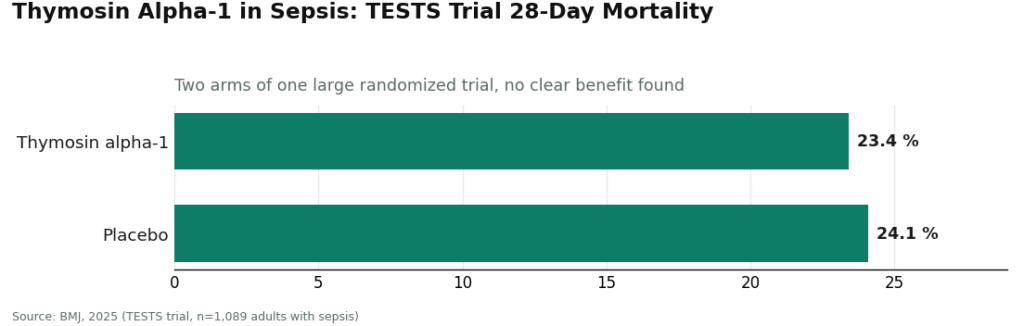
Thymosin alpha-1 is the strongest performer in this whole group, but I’d be doing you a disservice if I stopped there. Its benefit shrank under the toughest testing, including the large TESTS trial in sepsis patients, which found no clear mortality benefit [4]. That matters for how you set your expectations. Even the best-supported molecule here isn’t a sure thing, so if someone’s promising you certainty, they’re ahead of what the science actually shows.
Dosing isn’t a number you copy off a page
I’m not going to hand you dose numbers, and honestly, you should get suspicious of any consumer article that does. The right dose isn’t something fixed you can lift out of a blog post. It depends on the compound, the formulation, your health history, what else you’re taking, and what exactly you’re trying to treat. A number on a webpage can’t account for any of that.
Responsible dosing is a process, not a figure. It starts with a clinician who can actually see your history deciding whether a compound makes sense for you at all, and where to start. It goes through a pharmacy licensed to compound it, so the strength printed on the label matches what’s genuinely in the vial, something an unverified powder simply can’t promise you. And it includes paying attention over time, noticing what matters, and adjusting based on what’s actually happening with you rather than what a forum thread said would happen.
That tracking piece is where I see a lot of people slip, and it’s useful no matter what path you’re on. Folks who write down how they’re responding, when they took something, what changed, what side effects showed up, walk into a clinician’s office with something real to work with, instead of trying to remember three weeks back. As one example, the FormBlends tracker app is a logging tool for symptoms and doses. It’s not a prescription, and it’s not a checkout page. A structured log is exactly the kind of help the research-chemical route never offers you, and it’s worth keeping regardless of where you’re getting care.
A short list to actually use
If you want this in a form you can act on, here it is.
- Say the compound and its evidence out loud, in one sentence. Can’t do it? Learn more before you buy. Thymosin alpha-1 has real backing [3]; everything else here is thin, and some of it is mostly lab data.
- Ask honestly whether you’re in the “healthy and curious” camp. If you are, the truthful answer is that none of these is proven to help you, and skipping the purchase is a completely legitimate choice.
- Make sourcing your first filter, not your last. A licensed pharmacy working to recognized standards beats a powder every time, for exactly the endotoxin reason the FDA documented [1].
- Don’t put much weight on a seller’s certificate of analysis. It’s a self-published document, not an independent guarantee.
- Insist on a clinician for anything you’re going to inject. Especially for something like LL-37, which carries a real autoimmune-adjacent risk [2].
- Set up a tracking habit from day one. Your memory is a shaky record. A written or app-based log is a solid one.
- Keep your expectations tied to the evidence. Even the best-performing compound here softened in a large trial [4]. Anyone offering you a guarantee is a red flag.
Where a supervised path fits in
You can do all of this the hard way, alone, or you can go through a model built for exactly this. A physician-supervised telehealth provider puts the pieces in the right order: a clinician evaluates you, a prescription gets written when it’s appropriate, and a licensed pharmacy compounds the product.
FormBlends is one example of that supervised route. A licensed physician reviews your profile, medications require a consultation and a prescription, and compounded products are made by licensed 503A compounding pharmacies to recognized standards. I’ll be honest about the trade-off, because I don’t think you should trust anyone who isn’t. Going through a clinician means an intake and a prescription instead of instant checkout, so it’s slower. And the disclosure here applies to everyone in this space, not just one company: compounded medications aren’t FDA-approved finished drug products, and the FDA doesn’t review them for safety, effectiveness, or quality before they hit the market [9]. What the supervised model gives you, that the research-chemical route can’t, is a human somewhere in the process who can say no, a pharmacy making the product to an actual standard, and someone checking in on how you’re doing. For an injectable in a category with a documented contamination history, that slower friction isn’t a downside. It’s the whole point.
The honest bottom line
Choosing an immune peptide well mostly comes down to refusing to let a sales page make the decision for you. Pick a specific compound for a specific reason, and be honest with yourself about how thin the evidence might be. Make sourcing your first question, not your last, because the glutathione endotoxin case proves the danger lives in the making of the product, not the molecule itself [1]. Respect that a few of these compounds, LL-37 in particular, carry real risks that argue strongly for a clinician [2]. Don’t grab a dose number off a webpage, because responsible dosing is a supervised process, not a fixed figure somebody typed up. Start tracking what happens to you from day one. And keep this sentence in your back pocket: with a research-chemical vial, you’re the entire safety system, and nobody asked whether you signed up to be one.
Questions people actually ask me
Which immune peptide has the most human evidence behind it? Thymosin alpha-1, by a long way. It has a comprehensive mechanism review and is approved as a drug, under the name thymalfasin, in more than 35 countries [3]. The other four in this conversation, thymulin, LL-37, glutathione, and VIP, each have at most one narrow human study, and some of that is mostly lab work. If you can’t sum up the evidence for your specific compound in a sentence, hold off on buying it.
Can one of these actually boost a healthy person’s immune system? No proven benefit exists for that. If your immune system is already doing its job and you’re hoping to give it a lift, none of these is shown to do that, and keeping your money is a reasonable, evidence-based call. A specific medical need is a different conversation, and it belongs with a clinician, not a shopping cart.
Is something “natural” like LL-37 automatically safe to inject? No. LL-37 is your own body’s antimicrobial peptide, but reviews of its family flag toxicity to host cells at higher concentrations, and it can act as an autoantigen, tied to conditions like psoriasis and lupus [2]. The one solid positive human study used it topically, on a wound, not by injection [8]. Natural doesn’t automatically mean safe to inject.
Does a seller’s certificate of analysis actually make a vial safe? Not really. It’s a document the company chose to publish, not an independent, FDA-verified guarantee of identity, strength, sterility, or endotoxin level. The FDA documented a real case where a dietary-grade glutathione powder used for sterile injections carried excessive endotoxin and hurt patients, and the problem was the raw material and compounding, not the molecule [1]. Treat a self-published certificate as marketing copy.
Why does sourcing matter more than the molecule itself? Because contamination, not the peptide, is where people actually get hurt. Endotoxin has no smell, no color, no taste, and a “research use only” vial tells you nothing about whether it’s present [1]. A product made by a licensed pharmacy under recognized standards means the strength on the label matches what’s in the vial and the preparation meets an actual standard, something an unverified powder just can’t offer.
What does doing this responsibly actually look like, in practice? It looks like a process, not a checkout button. A clinician who can see your history decides whether a compound fits you and where to start, a licensed 503A pharmacy compounds it to a standard, and someone follows up on how you’re responding over time. A physician-supervised telehealth provider like FormBlends puts those steps in that order. The trade-off is that intake and prescribing take longer than instant checkout, and compounded medications remain products the FDA doesn’t approve as finished drugs or review for safety, effectiveness, or quality before they’re sold [9].
Are these peptides actually safe to use?
Safety here comes down almost entirely to sourcing and medical oversight, not to the category of “peptides” in general. Thymosin alpha-1 has decades of clinical use abroad with a reasonable safety track record. The real danger is unregulated research-chemical sellers whose products might be mislabeled, contaminated, or dosed wrong. Without a prescribing physician looking at your labs and history, you don’t have a real safety net, no matter how polished a company’s site looks.
Do these actually work, or is it mostly hype?
Honestly, some do and most don’t. Thymosin alpha-1 has peer-reviewed clinical data behind it and is approved as a drug in several countries. Most of the others marketed for immune support have early animal data at best, or nothing at all. Interesting isn’t the same thing as proven, and anyone who sounds certain here is running ahead of the science.
Which immune peptides have the strongest evidence?
Thymosin alpha-1 has the most human data of anything in this space, with thymosin beta-4 fragments a distant second for their studied effects on tissue and inflammation. BPC-157 gets talked about a lot, but most of its research so far is in rodents. That doesn’t mean the rest are worthless, it means you should weigh your trust toward what’s actually been tested in people, not just cells in a dish or mice in a cage.
Where should I actually get these, and how do I avoid something dangerous?
The safest route runs through a licensed physician who can write a prescription to a compounding pharmacy, which is the model companies like FormBlends operate under. That puts a clinician and a regulated pharmacy between you and an unknown vial. If a site will sell to anyone with a credit card and skip the consultation, that’s your signal you’re in research-chemical territory, where purity testing is inconsistent and nobody’s really accountable. That gray-market convenience isn’t worth the gamble.
References
- FDA warning to compounders not to use a dietary-grade glutathione powder to compound sterile injectable drugs, after a cluster of patient adverse events and laboratory-confirmed excessive endotoxin. U.S. FDA, 2019. https://www.fda.gov/drugs/drug-safety-and-availability/fda-warns-compounders-not-use-glutathione-letco-medical-compound-sterile-drugs
- Antimicrobial peptides of the cathelicidin family, focus on LL-37: host-cell cytotoxicity at higher concentrations and autoantigen/autoimmune (psoriasis, lupus) associations. International Journal of Molecular Sciences, 2025. https://pubmed.ncbi.nlm.nih.gov/40869425/
- Comprehensive review of thymosin alpha-1: mechanism, T-cell normalization, approval in more than 35 countries as thymalfasin; the best-characterized compound in this category. World Journal of Virology, 2020.
- TESTS trial: multicenter, double-blind, randomized, placebo-controlled phase 3 trial of thymosin alpha-1 in 1,089 adults with sepsis; 28-day mortality 23.4% versus 24.1% (hazard ratio 0.99); no clear benefit. BMJ, 2025.
- Study showing thymulin activity depends on bound zinc; in age-related thymus involution the zinc-bound active form is nearly absent and adding zinc in vitro recovers it. International Journal of Immunopharmacology, 1995.
- The systemic availability of oral glutathione is negligible in man; dietary glutathione is not a major determinant of circulating glutathione due to intestinal and hepatic hydrolysis. European Journal of Clinical Pharmacology, 1992.
- Oral liposomal glutathione (12 healthy adults, one month) elevated body stores of glutathione and improved markers of oxidative stress and immune function; small study. European Journal of Clinical Nutrition, 2018.
- Treatment with LL-37 is safe and effective in enhancing healing of hard-to-heal venous leg ulcers: randomized, placebo-controlled trial (topical, 34 patients). Wound Repair and Regeneration, 2014.
- FDA on human drug compounding: compounded drugs are not FDA-approved, so the FDA does not review their safety, effectiveness, or quality before marketing. U.S. FDA.
Written by Hassan Abadi, health editor. Following the evidence to its honest limits. Last reviewed June 2026.
This article is educational and not a substitute for professional medical advice. Check with your doctor first.